
Text 1
Bearbeite eine Textaufgabe deiner Wahl.
Text 1
Could this secret, decaying railway be New York’s next urban park?

 154 million in grants from the
4 billion and balloon to 9 billion. The group has
400,000 to study the rail idea from the US Department of Transportation.
(999 words)
Christopher Maag, “Could This Secret, Decaying Railway Be New York’s Next High Line?”, https://www.nytimes.com. From The New York Times, April 25, 2025 © 2025 The New York Times.
Annotations
1 Forest Hills, Ozone Park, Rego Park, Forest Park: neighborhoods in Queens
2 I-beam: a special kind of support beam
Outline the development of the Rockaway Beach Branch and the plans for its future use.
Analyze the writer’s portrayal of how both nature and humans reclaim the former train line. Focus on communicative strategies and use of language.
Choose one of the following tasks:
“One man can impose only so much order on a place so riotous. Rather than feel discouraged by the disorder, Mr. Mohamed greets it with delight. In summer, when the garden pruning is finished, he retires to his back deck. He watches darkness descend at its own celestial pace.” (ll. 72–75)
Taking this quotation as a starting point, comment on the importance of living in harmony with nature.
or
To mark World Cities Day, the United Nations Human Settlements Programme is collecting student perspectives on the future of urban life on its website.
Taking the message of the cartoon as a starting point, write an article in which you discuss whether cities should prioritize functionality and productivity over green spaces.
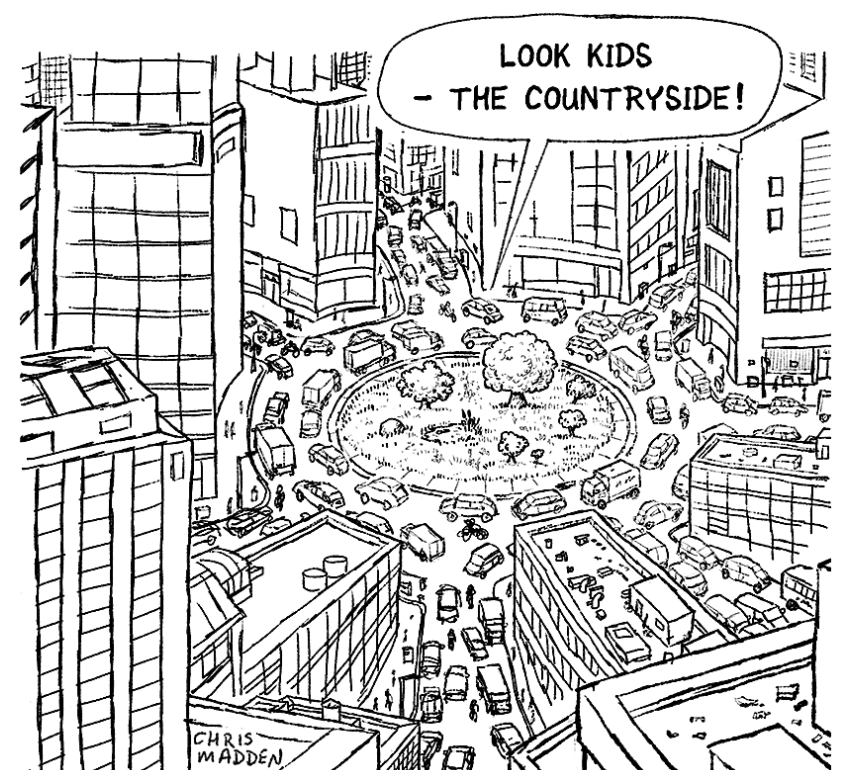
© Chris Madden / cartoonstock.com
Weiter lernen mit SchulLV Plus!
monatlich kündbarSchulLV Plus-Vorteile im ÜberblickDu hast bereits einen Account?Christopher Maag’s article details the historical trajectory and the contested future of the Rockaway Beach Branch, a former railway in Queens. Originally serving as a transit link to New York's beaches, the line was abandoned in 1962. Over the following decades, the 3.5-mile stretch was thoroughly reclaimed by nature, transforming into a dense, secluded urban forest. While parts of it are accessible, much of the area remains fenced off, though local explorers and homeless individuals frequently bypass these barriers. Currently, the site is the subject of competing redevelopment visions. A non-profit group aims to convert the overgrown tracks into a linear park, having already secured substantial funding for the project. Conversely, a rival organization advocates for restoring active train service to expand the subway system, a plan that would require billions of dollars. Amidst this bureaucratic indecision, local homeowners have informally appropriated the adjacent railway land, expanding their backyards to create private gardens and recreational spaces.
In his article, Christopher Maag employs vivid imagery, stark contrasts, and subjective observation to portray the dual reclamation of the Rockaway Beach Branch by both nature and local residents. Maag immediately establishes nature as a powerful, unstoppable agent. By using personification, stating that "nature pursued its messy designs" (l. 6), he frames the decay of human engineering as a deliberate organic takeover. This is reinforced by a series of short, paratactic sentences ("Forests grew. Signal towers fell.", ll. 6-7) that mimic the steady, inevitable progression of time. Furthermore, he uses a striking image of organic triumph: a maple tree entirely "folding the steel I-beam into its bulbous trunk" (l. 10), symbolizing nature physically consuming man-made structures. He embraces the paradox of "decayed beauty" (ll. 20-21), suggesting that the ruin is visually and atmospherically superior to a sterile urban environment. When portraying human reclamation, Maag highlights the creativity and agency of locals in contrast to bureaucratic institutions. He uses military metaphors, describing Patrick Mohamed’s gardening efforts as a "campaign of territorial expansion" (ll. 69-70) over his personal "domain" (l. 59). However, this is juxtaposed with peaceful, domestic imagery, such as "tomato beds [climbing] the hill like a staircase" (l. 56), framing the residents' actions as wholesome rather than hostile. Ultimately, Maag implicitly criticizes institutional planning. By contrasting the organic "celestial pace" (l. 75) of the wilderness with the developers' desire to aggressively "utilize every inch" (l. 31), he suggests that formal redevelopment threatens the spontaneous, unkempt magic that currently makes the abandoned railway so unique.
Finding the Middle Ground: Coexistence Over Control
Patrick Mohamed’s realization that he can "impose only so much order on a place so riotous" (ll. 72-73) beautifully captures the essence of living in harmony with nature. In a modern world obsessed with concrete expansion and environmental dominance, his approach serves as a crucial reminder that true balance requires humility rather than absolute control. Historically, humanity has treated nature as an adversary to be conquered. We have paved over ecosystems, straightened rivers, and heavily industrialized agriculture to maximize efficiency. While this has brought immense technological progress, the consequences—ranging from catastrophic climate change to devastating biodiversity loss—are undeniable. Conversely, the romanticized idea of completely surrendering to nature is equally impractical; human civilization requires shelter, infrastructure, and agriculture to survive. The true importance of living in harmony with nature lies in a sustainable middle ground. On a personal level, maintaining a connection to the natural world is vital for human well-being. Psychological studies consistently show that spending time in green spaces reduces stress and improves mental health. Like Mr. Mohamed enjoying the darkness at its "celestial pace" (l. 75), allowing ourselves to step away from artificial stimulation aligns us with natural rhythms. On a systemic level, harmony means integrating ecological principles into urban planning and industry. Initiatives like rewilding floodplains or creating urban green corridors prove that working with nature is often more effective and economically viable than fighting it. Ultimately, accepting our limits and respecting natural forces is not a sign of weakness, but the foundation for a resilient and healthy future.
The Green Illusion: Why Concrete Jungles Are Failing Us
Chris Madden’s cartoon, depicting a family excitedly pointing at a minuscule, traffic-choked roundabout tree and calling it "the countryside," perfectly captures a grim urban reality. As cities rapidly expand to accommodate growing populations, green spaces are frequently the first casualties, sacrificed on the altar of "productivity" and "functionality." However, treating nature as an expendable luxury is a dangerous misconception that ultimately undermines the very efficiency cities strive for. Proponents of aggressive urban development often argue that every square meter must be utilized to solve housing crises and build transport infrastructure. From a strictly short-term economic perspective, paving over a park to build an apartment complex or a new railway line seems highly functional. The demands of modern life dictate that people need affordable places to live and fast ways to commute. Yet, this narrow definition of productivity completely ignores the hidden costs of a concrete-dominated environment. Cities stripped of vegetation suffer from the "urban heat island" effect, where trapped heat leads to dangerous temperature spikes, increasing energy demands for air conditioning and causing severe public health crises. Furthermore, the lack of natural air filtration exacerbates respiratory diseases, while the absence of recreational spaces severely impacts residents' mental health, leading to stress and social isolation. Ultimately, green spaces are not merely decorative; they are vital, highly functional infrastructure. Trees and parks manage stormwater, cool the atmosphere, and foster community well-being—factors that directly contribute to a truly productive, resilient society. A city that prioritizes concrete over nature will eventually find itself unlivable, proving that ecology and functionality must go hand in hand.